
Adaptability and Resilience:
The Art of Thinking for Ourselves

Inspired by McKinsey’s research on adaptability and resilience, with reflections on independent thinking in the age of AI.

Introduction:
Why the Way We Think Matters More Than Ever
We have become remarkably good at finding answers. A question that once required hours of research can now be answered in seconds. Artificial intelligence can draft our emails, summarise complex documents, analyse information and suggest solutions before we have had much time to think about the problem ourselves.
There is considerable value in this progress. But it raises a question worth considering: when answers become effortless to obtain, what happens to our willingness to think through difficult questions?
Research is beginning to explore this tension. A 2025 study by Microsoft Research and Carnegie Mellon University, involving 319 knowledge workers, found that greater confidence in AI was associated with less self-reported critical thinking during AI-assisted tasks. The findings do not establish that technology inevitably weakens our abilities, but they raise an important question about how actively we engage with the tools we increasingly rely upon.
Perhaps the challenge is not simply learning to use new technology, but ensuring that we continue developing our own judgement alongside it.
This matters because life rarely presents us with a complete set of instructions. Plans change, opportunities disappear, people disagree and unexpected circumstances force us to reconsider decisions we once felt certain about.
In those moments, having access to more information is useful, but rarely sufficient. We also need the ability to question assumptions, recognise possibilities, manage disappointment and make decisions when the answers are not immediately obvious.
These are the foundations of adaptability and resilience.
Adaptability is our ability to adjust our approach when circumstances change. Resilience helps us recover from setbacks and continue moving forward. Neither requires us to remain positive all the time or pretend that difficulties do not exist.
Both begin with recognising how our thinking influences our response.
Consider two people facing an unfamiliar challenge. One thinks, “I have never done this before, so I probably cannot do it.” The other thinks, “I have never done this before, but I can learn.”
The situation is identical, yet their thinking opens up very different possibilities.
Drawing on McKinsey’s work, the following seven mindset shifts offer a practical framework for developing these abilities in our personal and professional lives.
Seven Mindset Shifts That Strengthen
Adaptability and Resilience


When things go wrong, it is natural to concentrate on circumstances beyond our control.
We may feel that other people’s decisions, limited opportunities or unexpected events are preventing us from progressing. Sometimes these difficulties are entirely real. However, focusing exclusively on what we cannot change can leave us feeling powerless.
An agent mindset encourages us to recognise where we still have influence.
For example, instead of thinking, “Nobody is giving me an opportunity, so there is nothing I can do,” we might ask, “What skills could I develop, who could I approach, or what opportunities could I create?”
This does not mean accepting responsibility for every difficulty we encounter. It means recognising that our circumstances do not always determine our next decision.
Questions worth asking:
- What is within my control?
- What strengths and resources do I already have?
- What practical step can I take next?
We may not always choose our circumstances, but we can often exercise greater influence over how we respond to them.

It is easy to become preoccupied with what we lack: time, money, experience, connections or support.
A scarcity mindset can lead us to dismiss possibilities before properly exploring them.
Imagine a small organisation with an ambitious project but limited funding. Its first reaction might be that the project is impossible.
A different approach would be to consider whether it could collaborate with another organisation, share resources, develop a smaller pilot or identify an alternative route.
An abundance mindset is not about pretending that resources are unlimited. It is about recognising that the resources immediately available to us may not represent every possibility.
Questions worth asking:
- What opportunities might I be overlooking?
- Could collaboration create a better outcome?
- Am I treating a temporary limitation as a permanent obstacle?
Sometimes progress begins not with acquiring more resources, but with thinking differently about those we already have.

Our instinct to protect ourselves from failure is understandable. We want to avoid disappointment, embarrassment, financial loss and unnecessary risk.
However, when avoiding failure becomes our main priority, we may also begin avoiding experiences that could help us grow.
Imagine being invited to speak at an important event. Your first thought might be, “What if I make a mistake? What if someone asks a question I cannot answer?”
An opportunity mindset introduces another perspective: “What could I learn from this experience? What conversations might it lead to? How could I prepare to make the most of it?”
The objective is not to disregard risk, but to give potential benefits the same consideration as potential difficulties.
Questions worth asking:
- What is the best realistic outcome?
- What might I miss by choosing not to try?
- How can I prepare properly and manage the risks?
Being cautious is sensible. Allowing fear to make every decision for us is limiting.

When something goes wrong, our immediate instinct is usually to solve the problem as quickly as possible.
This can be useful, particularly when urgent action is required. But reacting too quickly can also lead us to repeat familiar solutions without considering whether a different approach might work better.
A creative mindset encourages us to look beyond the immediate difficulty.
Suppose a project is no longer delivering the expected results. A reactive response might be to work harder to preserve the original plan.
A creative response would involve reconsidering the project’s purpose. Are we solving the right problem? Has something changed? Could another approach produce a better result?
Creativity does not always mean inventing something extraordinary. Sometimes it means recognising that the familiar solution is no longer the most appropriate one.
Questions worth asking:
- What are we actually trying to achieve?
- Is there another way to approach this problem?
- Could this setback reveal an opportunity to improve something?
Instead of concentrating solely on repairing what has gone wrong, creative thinking allows us to consider what could be done differently.

Most of us prefer having a clear plan. Knowing what to expect gives us direction and a sense of control.
Yet circumstances change, new information emerges and the approach that once seemed sensible may no longer be appropriate.
A certainty mindset can make changing direction feel like admitting that our original decision was wrong.
An exploration mindset recognises that a plan is a starting point, not a permanent commitment to one particular route.
Consider an entrepreneur developing a new product. After speaking with customers, they discover that people need something slightly different from what was originally proposed.
They could insist on following the initial plan, or they could use the feedback to develop a more relevant product.
The second approach does not represent a lack of conviction. It demonstrates a willingness to learn.
Questions worth asking:
- What have I learnt since making my original decision?
- What other approaches could I explore?
- Could a small experiment help me make a better decision?
Our ambitions can remain constant even when the route towards them changes. Knowing when to reconsider that route is an important part of adaptability.

Experience is valuable, but it can sometimes make us less willing to question what we already believe.
When we become accustomed to knowing the answers, admitting that we do not know something can feel uncomfortable.
An expert mindset may lead us to rely too heavily on familiar knowledge. A curious mindset encourages us to remain open to new information, alternative perspectives and unfamiliar ideas.
Imagine an experienced manager who has followed the same process for years. A younger colleague proposes a different approach.
Rather than dismissing the suggestion, the manager asks how it might work and whether it could improve the existing process.
This willingness to listen does not diminish the manager’s expertise. It allows that expertise to develop.
Questions worth asking:
- What might I be overlooking?
- Whose perspective have I not considered?
- What would I ask if I approached this situation with fresh eyes?
Experience can become a disadvantage when it makes us reluctant to question what we already know. The challenge is not simply to accumulate knowledge, but to remain willing to revise it.
This is particularly relevant in an age when technology can provide information almost instantly. We need more than the ability to retrieve answers. We need the judgement to question them, examine their assumptions and recognise when something deserves further investigation.
Knowledge tells us what we have learnt. Curiosity reminds us how much remains to be discovered.

A fixed mindset is the belief that our abilities are largely predetermined. We may assume that we are either naturally good at something or we are not.
This belief can discourage us from trying unfamiliar activities, particularly when we are afraid of making mistakes or appearing inexperienced.
A growth mindset recognises that abilities can develop through learning, practice, feedback and experience.
For example, someone who struggles with public speaking might think, “I am simply not a confident speaker.”
A more constructive response would be, “I am not confident yet, but I can improve through preparation and practice.”
The word yet makes an important difference. It allows us to acknowledge our present limitations without treating them as permanent.
Questions worth asking:
- What can this experience teach me?
- Which skill could I improve?
- What would meaningful progress look like?
A growth mindset does not suggest that effort alone guarantees success. Development also depends on circumstances, opportunities, appropriate support and effective learning.
It simply reminds us that our present abilities do not necessarily define our future potential.
Putting These Mindsets Into Practice
Understanding these seven shifts is useful, but their real value comes from applying them to everyday situations.
One practical starting point is self-reflection.
Think about a recent experience that did not go according to plan. Perhaps you received criticism, missed an opportunity, disagreed with a colleague or struggled with something unfamiliar.
Consider your immediate reaction.
Did you become defensive? Did you assume the situation was beyond your control? Did you concentrate on what had gone wrong, or did you consider what you could learn?
Our initial reactions often reveal the assumptions influencing our behaviour.
A useful exercise is to ask ourselves three questions:
- What am I thinking and feeling about this situation?
- Is my current way of thinking helping me respond constructively?
- Is there another perspective that might help me move forward?
Imagine applying for an opportunity and receiving a rejection.
Your immediate thought might be, “I am clearly not good enough.”
Disappointment is understandable, particularly when something matters to us. However, instead of treating the rejection as a final judgement of our abilities, we could consider whether there is anything useful to learn.
Perhaps we need to strengthen a particular skill, seek feedback or explore a different opportunity.
Changing our mindset does not remove disappointment or guarantee a different outcome. It allows us to acknowledge the experience without allowing it to determine every decision that follows.
The aim is not to suppress difficult emotions. It is to recognise them while retaining the ability to think clearly about what comes next.
Better Questions Lead to Better Thinking
The questions we ask influence what we notice, what we consider possible and where we direct our attention.
When we repeatedly ask why something has gone wrong, we may become preoccupied with the difficulty itself.
When we begin asking what we can learn or influence, we create room to consider our next steps.
Small changes in language can therefore make a meaningful difference.
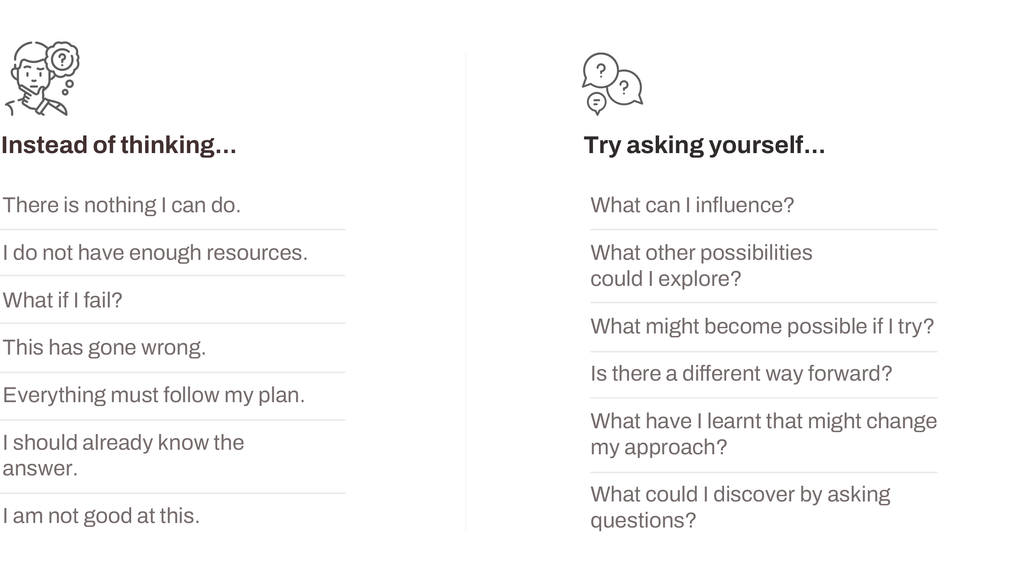
These questions are not intended to make us overlook genuine difficulties or force ourselves to remain optimistic.
Their purpose is to encourage us to consider a broader range of possibilities before deciding how to respond.
This is also an important distinction when using artificial intelligence.
AI can help us explore ideas, organise information and consider different perspectives. But accepting an answer without examining it is not the same as understanding it.
We can use technology to support our thinking by asking it to challenge our assumptions, present alternative arguments or identify gaps in our reasoning.
The important question is whether we are using these tools to strengthen our judgement or allowing them to replace the effort of forming one.
A Simple Exercise: Think Before You React
The next time you encounter an unexpected problem, resist the temptation to look immediately for an answer.
Spend a few minutes considering four questions:
1. What am I assuming?
Separate what you know from what you believe to be true. Sometimes our first interpretation of a situation is based on incomplete information.
2. What am I overlooking?
Consider another explanation, perspective or possibility. Ask whether someone with a different background or experience might see the situation differently.
3. What can I influence?
Distinguish circumstances beyond your control from actions available to you. This can help redirect your attention towards something constructive.
4. What would I do differently?
Identify one practical action rather than waiting for a perfect solution. It might be seeking feedback, having a difficult conversation, testing an idea or reconsidering an earlier decision.
These questions bring together several of the seven mindset shifts. They encourage us to think before reacting, question our assumptions and approach difficulties with greater clarity.
They are equally useful when working with AI. Before asking a tool to solve a problem, try forming your own initial view. Then use the technology to challenge, develop or test your thinking.
The purpose is not to avoid assistance, but to remain intellectually engaged in the process.
Bringing Adaptability and Resilience Into Our Teams
Adaptability is not only an individual quality. It also influences how people work together, particularly when organisations face uncertainty, disagreement or unexpected change.
A team becomes more adaptable when its members feel comfortable sharing ideas, acknowledging mistakes and reconsidering decisions without unnecessary fear of criticism.
Whether we are leading others or working alongside colleagues, four everyday practices can help create this environment.
Lead by example
People often take their cues from how those around them behave, particularly their leaders.
If we want others to remain open-minded, we must demonstrate that willingness ourselves.
This includes acknowledging when we do not know something, listening to different opinions and being prepared to change our minds when new information becomes available.
For example, a manager might say, “I originally thought this was the right approach, but having considered everyone’s suggestions, I think there may be a better way.”
This demonstrates that reconsidering a decision is not necessarily a weakness. It can reflect thoughtful judgement.
Encourage constructive conversations
The language we use in meetings can influence whether people concentrate on blame or problem-solving.
When a project encounters difficulties, instead of asking only who made the mistake, we can also ask what happened, what can be learnt and how the team should proceed.
Questions such as “What are we overlooking?” or “Is there another way to approach this?” encourage people to contribute ideas rather than simply defend their existing positions.
Help people recognise and reconsider their assumptions
Stress and frustration can make us more attached to our initial reactions.
When a discussion becomes difficult, it can be helpful to encourage colleagues to recognise the assumptions influencing their responses.
For example, if a project is running behind schedule, the conversation may become focused on everything that has gone wrong.
A more productive question might be, “Given where we are now, what can we realistically influence, and what should we prioritise next?”
This acknowledges the difficulty without allowing it to dominate every subsequent decision.
Recognise positive behaviour
People are more likely to repeat behaviours that are noticed and valued.
When a colleague asks a thoughtful question, admits a mistake, shares a useful lesson or suggests a different approach, acknowledging that contribution can encourage similar behaviour across the team.
Recognition does not need to be elaborate. A simple expression of appreciation can reinforce the importance of curiosity, openness and constructive problem-solving.
Over time, these everyday interactions can help establish a working environment in which learning and adaptability become part of the team’s culture.
Why Independent Thinking Matters for Leadership
Leadership often involves making decisions without having complete information.
Markets change, projects encounter difficulties, people disagree and unexpected circumstances can make an established strategy less effective.
In these situations, leadership is not simply about maintaining confidence or having an immediate answer. It is also about recognising when to listen, when to reconsider and when to take a different approach.
The seven mindset shifts offer a useful foundation for developing these qualities.
Personal agency helps leaders concentrate on the decisions they can influence. An abundance mindset encourages resourcefulness and collaboration. Opportunity thinking allows them to consider potential benefits without overlooking risks.
Creative thinking helps leaders explore alternatives when familiar methods are no longer effective, while an exploration mindset encourages them to adjust plans as circumstances change.
Curiosity reminds leaders that experience does not eliminate the need to keep learning. A growth mindset encourages them to see development as an ongoing process, both for themselves and for the people they lead.
These qualities become especially relevant as AI takes on a greater role in professional decision-making.
Having access to sophisticated technology does not remove the need for human judgement. Leaders still need to understand the problem they are trying to solve, question the information presented to them and consider the consequences of their decisions.
A convincing answer is not necessarily a correct one, and an efficient solution is not always the most appropriate one.
Technology can support analysis, but responsibility for judgement cannot simply be delegated to a machine.
This is why independent thinking, adaptability and resilience belong in the same conversation.
A leader can remain committed to a clear purpose while being flexible about how that purpose is achieved. Equally, they can welcome technological progress without surrendering the curiosity and critical thinking required to use it responsibly.
Conclusion:
Thinking for Ourselves in a Changing World
Adaptability and resilience are not qualities that we either possess or lack. They can be strengthened through experience, reflection and consistent practice.
The seven mindset shifts remind us that our first interpretation of a situation is not necessarily the only one available.
We can move from feeling powerless to recognising our choices, from concentrating on limitations to exploring possibilities, and from fearing failure to considering what an experience might offer.
We can learn to respond creatively, remain flexible when plans change, question what we think we know and recognise that our abilities can continue to develop.
None of this means that every challenge can be overcome through positive thinking. Some circumstances are genuinely difficult, and not every problem has an immediate solution.
However, becoming more aware of our thinking can help us make better decisions about how to respond.
As artificial intelligence becomes increasingly integrated into our lives, the importance of these abilities deserves renewed attention.
We should welcome tools that make information more accessible and help us work more effectively. But convenience should not come at the expense of curiosity, independent judgement or our willingness to work through difficult questions.
There is value in not knowing something immediately. There is value in questioning an assumption, changing our minds when presented with better evidence and discovering a solution through our own efforts.
Ultimately, adaptability is not about constantly changing who we are or what we want to achieve. Resilience is not about never feeling disappointed or overwhelmed.
Both begin with recognising that, even when we cannot control everything around us, we can become more thoughtful about how we respond.
In a world where answers are increasingly easy to obtain, perhaps one of the most important abilities we can preserve is the willingness to think for ourselves.
References and further reading
1. McKinsey & Company —
Future proof: Solving the adaptability paradox for the long term
The underlying seven-mindset framework.
2. Microsoft Research and Carnegie Mellon University (2025) —
The Impact of Generative AI on Critical Thinking
Research involving 319 knowledge workers on self-reported critical thinking during AI-assisted work.